_LOGO.png)


I think at some point in our lives, most of us have experienced the frustration of retrieving medical records or waiting on hold just to book an appointment. Vitrica is a mobile healthcare app that gives users seamless access to their own health data and their dependents' - with secure sharing built in from the start, not added on.

Users described existing health apps as cluttered and hard to trust: one called account setup 'confusing and time-consuming,' another said the design 'feels outdated.' Several also noted that sharing records with family members or providers felt like an afterthought; bolted onto apps that were built around a single user, not a household."
3 men and 2 women (ages 22-48) were interviewed. The clearest theme: users didn't just want easier navigation - they wanted to feel in control of who could see their data.
Vitrica was designed to support a wide range of users, from tech-savvy young adults managing their own personal health, to older generations - often parents - seeking a clear and dependable way to access and share their medical records.

A stay at home mother that loves reading and spending time with her children. With her eldest child getting ready to start going to school, she needs a way to access and share her child’s medical records, but being a mother of two boys, can’t find time to go to the doctor’s office.

Brian is a college student who loves sports and staying active. He actively participates in student sports club organizations and works a part time job as a referee for these sports games, which means he has to consistently submit his medical records. He also takes care of his father, and desires a way to quickly access secure data.

Todd is a hardworking, passionate, single father that does nothing but work in order to support his daughter in whatever way he can. His daughter wants to participate in school sports, so he needs a way to easily make appointments with her provider, and share her health information with the school.

Designing Vitrica's user flow and IA began with mapping the most essential user goals: accessing/sharing records, booking appointments, finding nearby doctors, paying bills, and managing proxy access. Proxy access got equal billing with core actions like booking appointments - a direct response to how many participants described managing care for a child or parent, not just themselves.


For initial wireframing, I prioritized a clean, function-focused layout over visual flourish. Every screen was built around a single linear task path, so a user under stress (i.e. booking an urgent appointment) never has to guess what to do next.
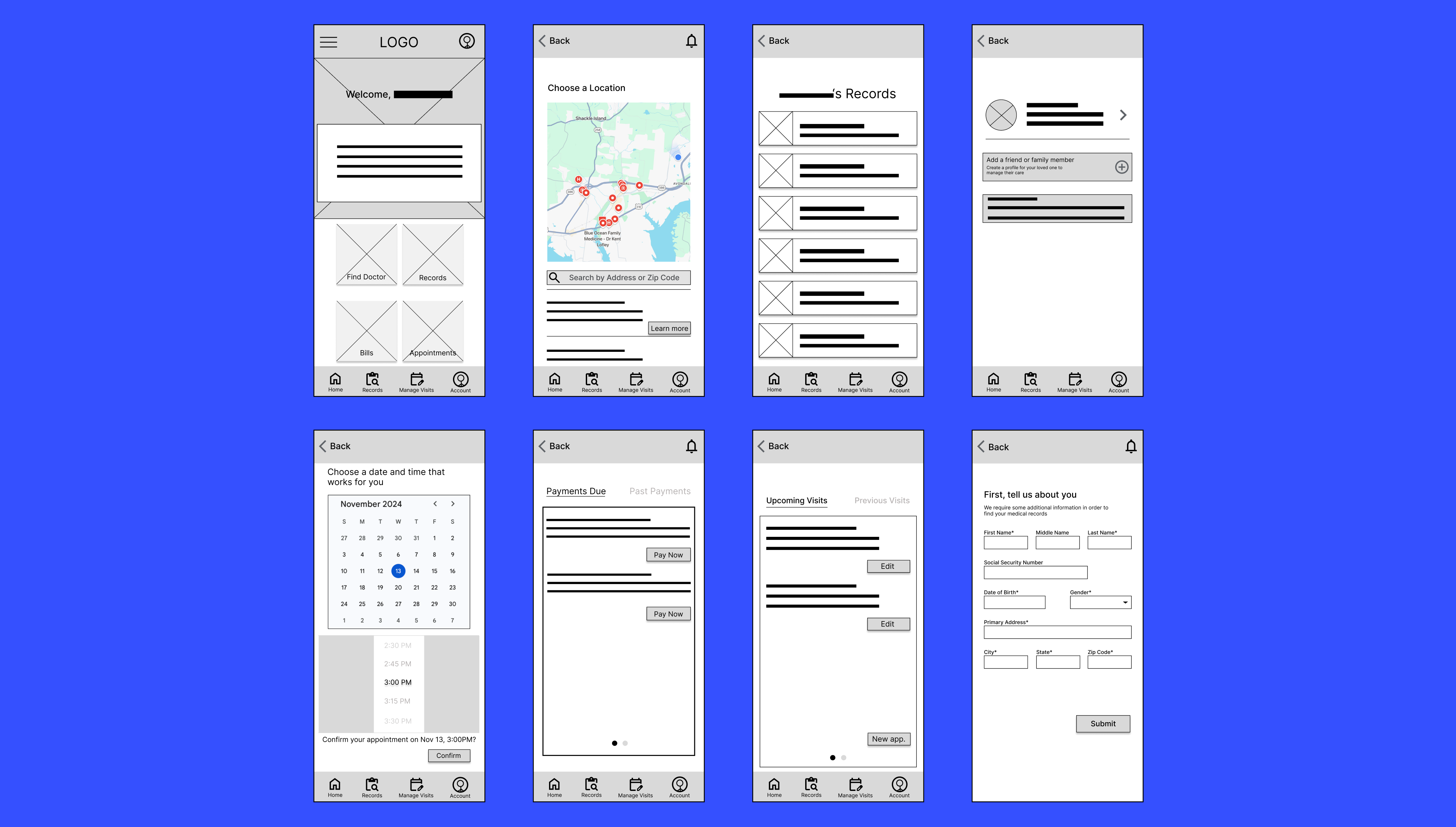
Feedback from early usability testing helped refine the structure and highlighted opportunities to add an additional feature heavily requested by users, which was updated in the high-fidelity mockups, as well as the user flow. (Messaging/chatting providers)
I also considered folding Pay Bills into the Account settings, but researched indicated users expected billing to be a top-level action alongside record viewing and appointments, so I kept it as its own nav item.

The name "Vitrica" blends "Vital" and "Records." Early drafts leaned on a literal EKG line, but that read as clinical rather than reassuring; so the final mark centers a bold "V" instead, aiming for trustworthy without feeling sterile.
%20ideas.png)
I created an easy to understand sticker sheet for individuals to use as a reference for Vitrica’s UI elements.
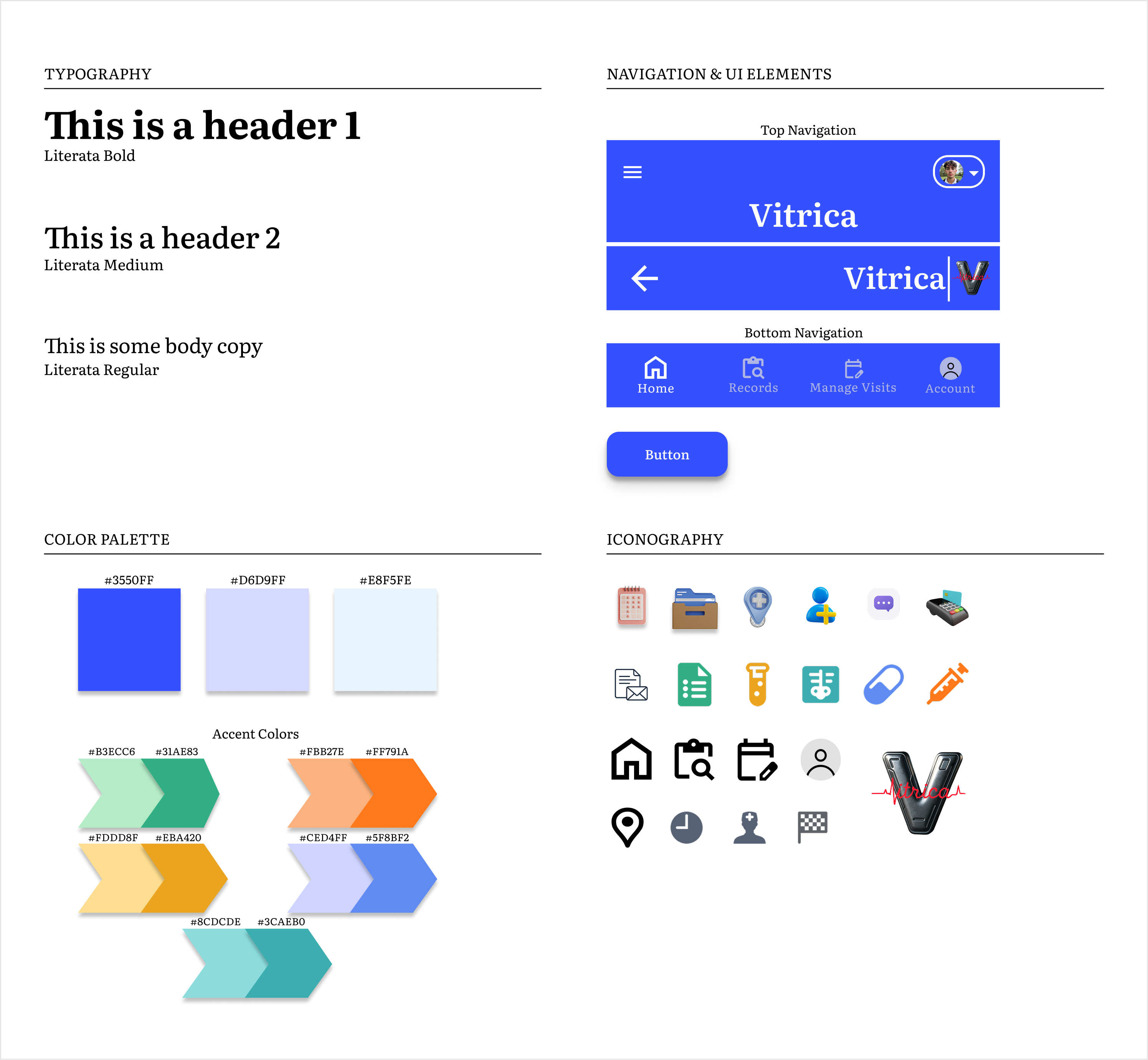
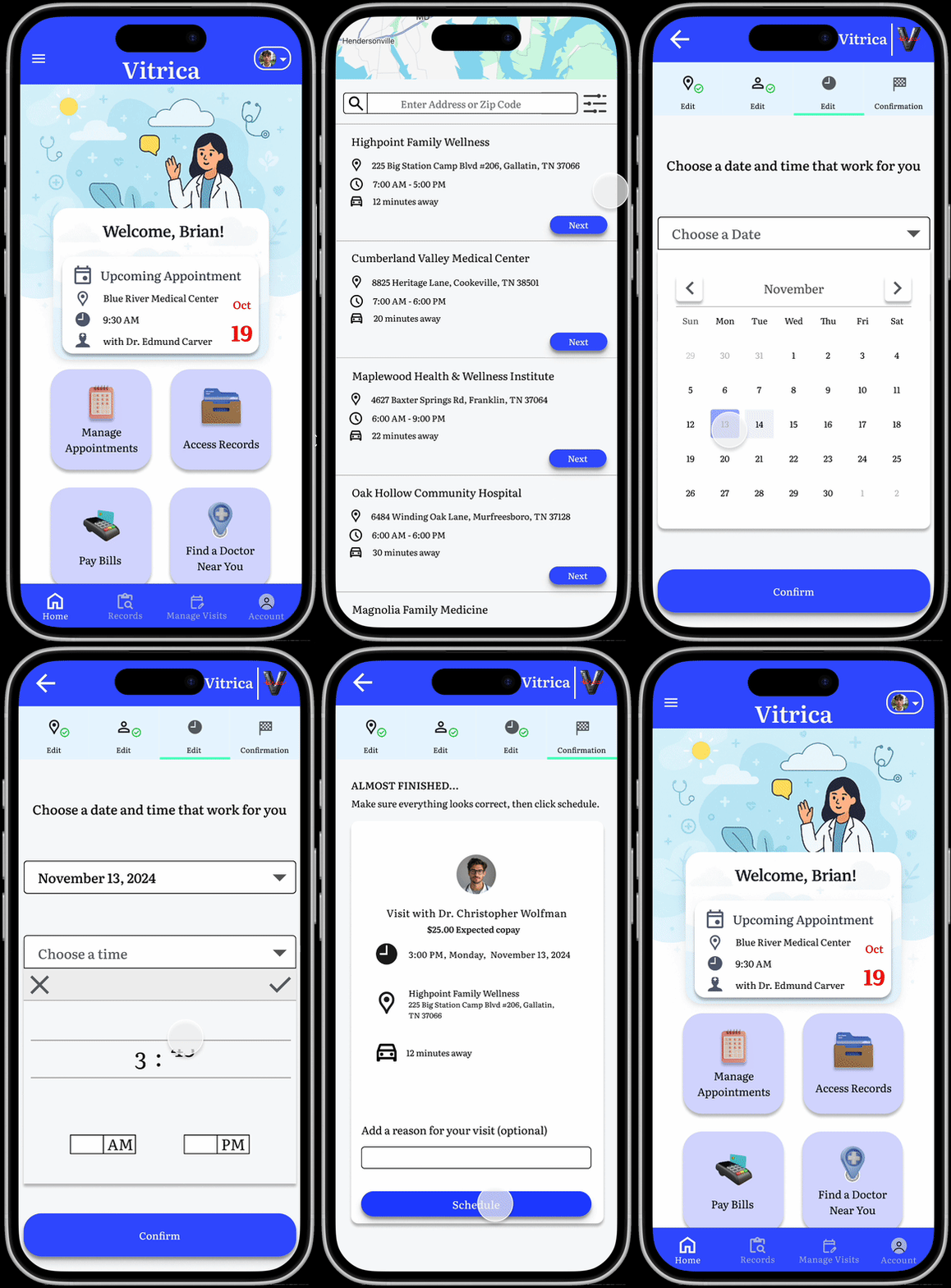
With wireframes in place, I moved to high-fidelity mockups in Figma. The main goal being humanizing a typically clinical experience through a calm color palette, modern typography, and custom illustrations instead of the sterile look most health apps default to.
Although this wasn't a live product, I treated retention as the north-star metric for testing, since the core problem I was solving was app abandonment, not just task failure.
Some sample questions asked during user interviews:
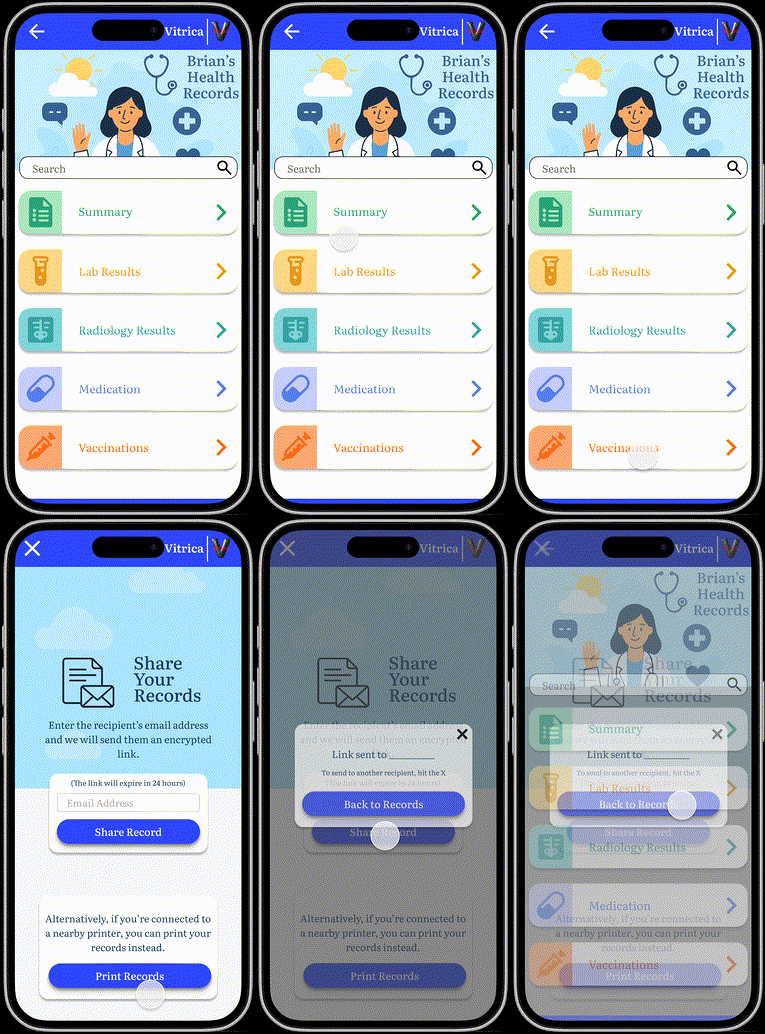
All 5 participants completed the core tasks (i.e. booking an appointment, sharing a record, adding a proxy connection, etc.) without assistance.
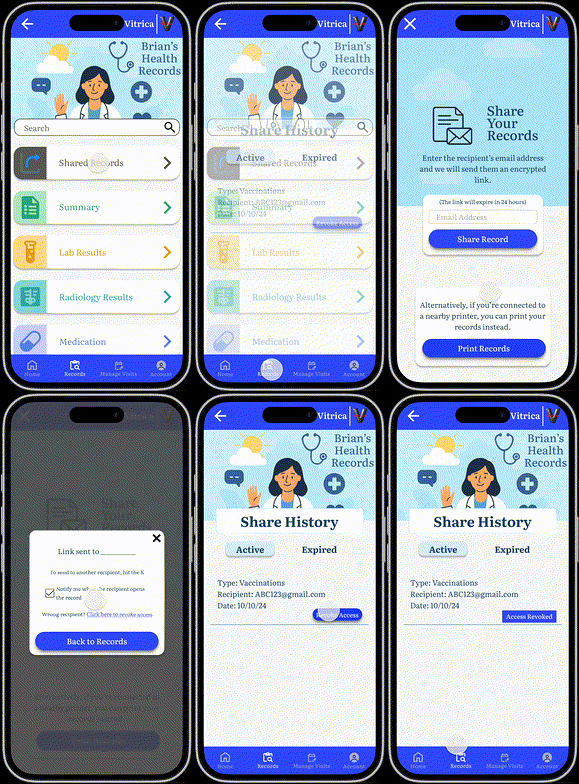
The final change I made before handoff was adding real-time "opened" notifications, a sharing history log, and a "revoke access" feature; directly targeting the trust and control concerns that came up repeatedly in interviews, rather than just adding features for their own sake.
Success for this MVP would be measured through user activity, retention, task completion/error rates, and feature usage. Retention mattered most, since the original problem was users abandoning cluttered, low-trust health apps, so keeping people in the product past onboarding is the real test of whether Vitrica solved anything.
Once these post-launch metrics are more clearly discovered, we can determine the features that are worth iterating upon.
1. Depending on the success rate and user feedback, tailor which features on the app need to be boosted/tweaked or potentially even removed.
2. Building and expanding partnerships with hospitals/providers in order to integrate more external systems for seamless record import.
3. Explore potential feature expansions such as: integration with wearable devices and AI-driven health insights.
Designing Vitrica pushed me to combine functionality, empathy, and clarity in a high-stakes context, and taught me that trust and emotion turned out to matter as much as usability in a healthcare product.
The biggest shift in my thinking: designing for the user doesn't mean designing in isolation from the business. Building a full concept end-to-end meant balancing user needs against business and technical constraints, not just optimizing for the user in a vacuum.